Nautilus software for automated
nucleic acid building
K
Cowtan
The 'nautilus' software is a
new tool for automated building of RNA/DNA from electron density. It uses
similar ideas to the 'buccaneer' software (Cowtan, 2008) for protein model
building, but with a different and highly efficient target function for identifying
nucleotide features.
The software will locate
likely nucleotide features including sugars and phosphates, grow these into
chains, merge overlapping chains, match the built chains to the sequence, and
build the bases. The resulting structure is refined using 'refmac', and the
calculation is iterated to obtain a more complete structure.
The software may be used to
build nucleotide structure in experimentally phased maps, molecular replacement
maps, or to add the nucleotide components to protein complexes.
The calculation consists of
the following steps:
- Locate
likely phosphate and sugar features in the electron density.
- Grow the
features into chains.
- Merge
overlapping chains.
- Join
chains whose 3' and 5' ends are in close proximity.
- Rebuild
the chains using fragments from the Richardson's database of well
determined nucleotide structures.
- Match the
chains against the known sequence.
- Build the
bases and other peripheral atoms.
The calculation is notable
for its speed, typically taking no more than a few tens of seconds. When
combined with refinement in refmac (itself a fast package) (Murshudov et al,
1999), more than 90% of the time is spent in the refinement step. This speed is
achieved through use a highly optimised 'fingerprint' for detecting structural features
from the electron density values at a few highly informative points, which must
have extreme density values if the feature is present in a given orientation. A
fast rotation and translation search can be carried out using a method similar
to the that employed by the ESSENS software (Kleywegt
& Jones, 1997). The fingerprint for a sugar group is shown in figure 1.
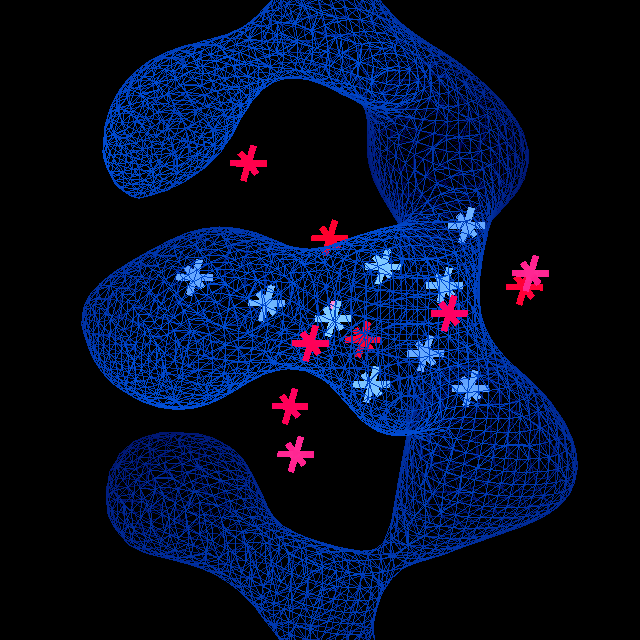
Figure
1: Nautilus sugar fingerprint. Blue crosses are locations where high density is
required, red crosses are locations where low density is required.
Similar fingerprints are used
to identify phosphates and to distinguish between different base types.
Version 0.3 of Nautilus is
included in CCP4 version 6.3.0. The pipeline may be run through the CCP4i
graphical user interface, or from the command line as
either a build/refine pipeline or for a fast build only. In future an interactive
version of some of the functionality will be available in the 'Coot' model
building software (Emsley et al, 2010).
This article may be cited
freely.
References
- Kleywegt,
G. J. & Jones, T. A. (1997). Acta Cryst. D53, 179-185.
- Murshudov
G. N., Lebedev A., Vagin A. A., Wilson K. S. and Dodson E. J. (1999). Acta
Cryst. section D55, 247-255.
- Cowtan, K.
(2008). Acta Cryst. D64, 83-89.
- Emsley,
P., Lohkamp, B., Scott, W. G. & Cowtan, K. (2010). Acta Cryst. D66,
486-501.