Composite omit maps with 'comit'
K
Cowtan
The 'comit'
software calculates composite omit maps (Bhat, 1998)
by omitting spheres of density from the asymmetric unit and reconstructing
those spheres using sigma-a weighted maps to restore the omitted density.
Unlike the existing omit map task, 'comit' uses refmac for its structure factor calculations, and thus
makes full use of the latest features provided by 'refmac'
(Murshudov et al., 1999).
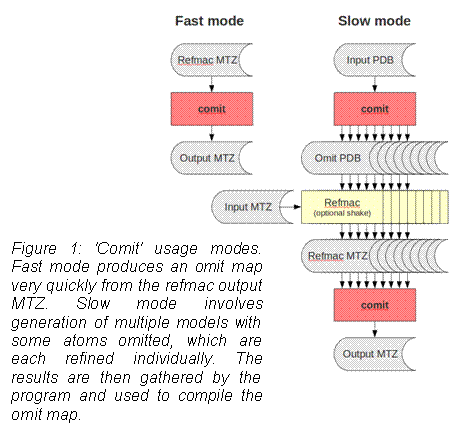
The program can use one of
two modes. A fast calculation using the output from refmac
can generate a very good approximation to the full composite omit map with the
correct choice of input MTZ columns. A slow calculation involves re-running refmac on multiple versions of the model with a few atom
occupancies set to zero in each case. In slow mode the program is run twice,
once to generate the input models for refmac, and
once to assemble the output map from refmac. The two
usage modes of 'comit' are shown in figure 1.
The slow mode, with
refinement of all the omit models, should in theory lead to less bias. In practice,
the fast mode produces similar results if the 'refmac'
FC_ALL/PHIC_ALL columns are used for the initial map calculation (rather than
FWT/PHWT which lead to a more biased and double-weighted map).
The program is included in
CCP4 6.3.0. Fast mode may be used through the graphical user interface. Slow
mode currently requires a simple script; an example is provided in the
documentation.
Citations for the use of comit should be made to the main CCP4 reference (Winn et
al, Acta Cryst 2011).
References
- Bhat,
T. N. (1988). J. Appl. Cryst. 21, 279-281.
- Murshudov
G. N., Lebedev A., Vagin A. A., Wilson K. S. and Dodson E. J. (1999). Acta Cryst. section D55, 247-255.
- Winn M. D.
et al. (2011). Acta Cryst.
section D67, 235-242.